
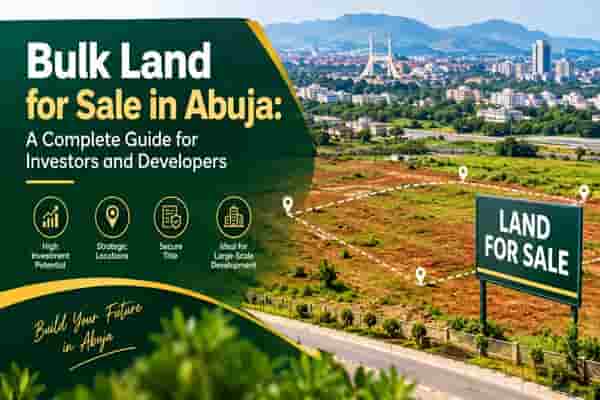
Buying one residential plot is very different from acquiring several plots or multiple hectares of land. While an individual buyer may be looking for a place to build a home, a developer or investor purchasing bulk land in Abuja must consider a much wider range of factors, including location, title documentation, accessibility, development potential and the cost of holding the property. (bulk land for sale in Abuja)
A large parcel of land can create opportunities for estate development, land banking, commercial projects and other long-term investments. However, the size of a property does not automatically make it a good investment.
The real question is whether the land is suitable for your objectives, whether the transaction is legally sound and whether the numbers make sense.
If you are searching for bulk land for sale in Abuja, here are the key considerations to understand before committing your money.
What Is Bulk Land?
Bulk land refers to a large parcel of land acquired in a single transaction or through a coordinated purchase of multiple plots. Depending on the purpose of the acquisition, it may consist of several plots combined into one parcel or land measured in hectares.
There is no universal minimum size that defines every bulk-land transaction. The scale depends on the buyer’s requirements and the nature of the proposed project. (bulk land for sale in Abuja)
For example, an estate developer may require several hectares to build a residential community. A property investor may acquire a large parcel for long-term land banking, while a company may need substantial land for future expansion. (bulk land for sale in Abuja)
In Abuja, the suitability of such a property depends not only on its size but also on its location, planning restrictions, documentation and intended use.
Why Do Developers and Investors Buy Bulk Land in Abuja?
For property developers, land is one of the most important decisions in a project. The wrong acquisition can affect construction costs, development timelines and the ability to sell or lease the completed properties.
Investors also approach large land purchases differently from ordinary residential buyers. Their decisions often involve longer holding periods, substantial capital and an assessment of future demand.
Here are some of the main reasons buyers consider bulk land.
1. Estate Development
Developers looking to build residential estates need sufficient land for housing, internal roads, drainage, utilities and other supporting infrastructure.
The required acreage will depend on the proposed development, applicable planning requirements and the number and type of units involved.
A property that appears large enough on paper may not provide the expected developable area once access roads, setbacks, drainage corridors and other planning requirements are considered.
Before purchasing, developers should establish whether the parcel can realistically accommodate the intended project.
2. Long-Term Land Banking
Some investors acquire land with the intention of holding it for several years rather than developing it immediately.
Their investment decision may be influenced by surrounding development, road access, population growth and the potential for future demand.
However, land banking requires patience and careful financial planning. Land may take longer than expected to appreciate or attract a suitable buyer. Meanwhile, the owner may incur legal, security, maintenance and other holding costs.
Future appreciation should therefore be treated as a possibility, not a guarantee. (bulk land for sale in Abuja)
3. Joint Ventures and Development Partnerships
A landowner may partner with a developer who has the technical expertise, financing or capacity to execute a project.
Depending on the arrangement, the landowner may contribute the land while the developer provides funding, construction and project management.
Such partnerships can create opportunities, but they also introduce contractual and financial risks. The parties should clearly agree on their respective contributions, ownership interests, responsibilities, profit-sharing arrangements, project timelines and dispute-resolution procedures.
Independent legal advice is important before signing a joint venture agreement.
Where Should You Look for Bulk Land for Sale in Abuja?
The right location depends on what you intend to do with the land. A parcel suitable for a residential estate may not be appropriate for agriculture, warehousing or another commercial purpose.
Rather than choosing a location simply because it is popular, evaluate it against your development plans and investment objectives.
Consider the following factors when comparing opportunities across Abuja and its surrounding areas. (bulk land for sale in Abuja)
- Accessibility: Is the property accessible by an existing road? What is the condition of the access route, and would the proposed development require additional road construction?
- Surrounding development: Are there existing communities, residential estates, commercial activities or other developments that may support demand?
- Infrastructure: What is available in terms of electricity, water, drainage and other essential services? What would it cost to provide missing infrastructure?
- Planning and permitted use: Is the proposed use compatible with the applicable land-use designation and planning requirements?
- Market demand: Who is likely to buy, occupy, lease or develop the property in the future?
- Acquisition cost: Beyond the asking price, what expenses will be required to make the land suitable for the intended project?
For a more detailed discussion of location selection, read our guide on where to buy hectares of land in Abuja for estate development.
The important thing is to assess each property individually. Two parcels in the same general area can have very different investment prospects because of differences in access, title, permitted use and surrounding conditions.
A Low Price Per Hectare Does Not Automatically Mean a Good Deal
When buyers compare bulk land offers, the price per hectare or plot can be an attractive starting point. It should not, however, be the only basis for making a decision.
A parcel may be cheaper because it is farther from established infrastructure, has difficult access, requires additional work or presents unresolved documentation issues.
These possibilities do not automatically make the property a bad investment, but they need to be investigated.
Before accepting an attractive price, ask yourself:
- Why is the seller offering the property at that price?
- Is the land accessible throughout the year?
- Are the title and ownership records satisfactory?
- Will additional expenditure be required before development can begin?
- Does the asking price reflect comparable properties with similar characteristics?
- Is the property suitable for the project you intend to execute?
It is also important to calculate the total acquisition cost rather than focusing exclusively on the seller’s price.
Depending on the transaction, additional expenses may include legal and professional fees, surveys, title-related charges, applicable taxes and duties, security, infrastructure and site preparation.
A good bulk-land acquisition is not necessarily the cheapest one. It is one whose price, legal position, physical characteristics and intended use make commercial sense together.
Verify the Title and Ownership Before Paying
Documentation is one of the most important parts of buying bulk land in Abuja. A large parcel can appear promising, but the investment is exposed to significant risk if the seller cannot establish a valid right to transfer the property.
Do not rely solely on a photocopy of a title document, a seller’s explanation or assurances from an intermediary.
A proper investigation should cover the following areas. (bulk land for sale in Abuja)
Confirm the Seller’s Right to Sell
Establish who owns the land and whether the person or company negotiating the transaction has the legal authority to sell it.
Where a company, family, estate or other group owns the property, the required authorisations and the identities of the relevant parties should be verified. (bulk land for sale in Abuja)
Examine the Available Title Documents
Request the documents supporting the seller’s interest in the property. Depending on the circumstances, these may include a Certificate of Occupancy, a registered deed, an allocation document or other relevant records.
The existence of a document does not, by itself, establish that the transaction is safe. Its authenticity, legal significance, registration status and relationship to the specific parcel must be investigated.
Verify the Survey and Boundaries
Engage an appropriately qualified surveyor to establish the property’s location, boundaries, dimensions and relationship to the land being offered.
This is particularly important when purchasing several hectares, where discrepancies between advertised acreage and the actual parcel can have substantial financial consequences.
Investigate Planning and Encumbrances
Appropriate checks should establish whether the land is affected by competing claims, existing interests, mortgages, acquisition notices, planning restrictions, rights of way or other matters that could affect ownership or development.
For land in the Federal Capital Territory, the relevant checks will depend on the property’s location, title history and status. A qualified property lawyer should advise on the appropriate verification process and relevant authorities.
For a transaction involving substantial capital, independent legal and technical due diligence should be completed before payment or the execution of binding commitments. (bulk land for sale in Abuja)
Check the Actual Development Potential
Owning a large parcel does not necessarily mean you can develop it exactly as you wish.
The proposed project must be assessed against the applicable land-use designation, planning approvals, environmental considerations and infrastructure requirements.
For instance, a developer planning a residential estate needs to understand the permitted use of the land and the practical implications of providing roads, drainage, utilities and other facilities.
A parcel intended for a different purpose may require a different assessment.
Before proceeding, establish:
- The land use applicable to the property.
- Whether the intended development is permissible.
- Whether additional approvals or consents will be required.
- The approximate area that can realistically be developed.
- The infrastructure and site-preparation costs involved.
- Whether any restrictions could affect the project’s feasibility.
This assessment helps prevent a situation where a buyer acquires land based on an attractive development concept that cannot be implemented as originally planned.
Have an Exit Strategy Before You Buy
One question every serious investor should answer is: What is my plan after acquiring this land?
Your answer will influence the location you choose, the amount you can reasonably pay and the length of time you can afford to hold the property.
If you intend to develop an estate, you need a realistic assessment of construction costs, funding requirements, target buyers and likely sales timelines.
If you intend to hold the land, you need to consider the length of your investment horizon, the cost of maintaining the property and the circumstances under which you would sell.
If your strategy depends on reselling the parcel to another developer, consider whether the size, location, title and permitted use are likely to suit the needs of that market.
A clear exit strategy does not eliminate investment risk. It helps you identify the assumptions behind your decision and determine whether the opportunity is worth pursuing.
What Other Costs Should You Budget For?
The asking price is only one component of a bulk-land acquisition.
The total amount required will depend on the property, the transaction structure and the proposed use. A practical budget should consider the following:
- Purchase price and agreed payment terms.
- Legal fees and professional due-diligence costs.
- Surveying and boundary verification.
- Applicable registration charges, taxes and duties.
- Relevant title-related expenses.
- Site clearing, access roads and other necessary infrastructure.
- Security and ongoing holding costs.
- Planning, design and other project-development expenses where applicable.
Not every expense will apply to every transaction. Obtain professional advice and realistic cost estimates before committing funds.
A property that appears affordable at the acquisition stage may require substantially more capital before it becomes suitable for development or resale.
Questions to Ask Before Buying Bulk Land in Abuja
Before making payment, use the following checklist to guide your discussions with the seller and your professional advisers.
- What exactly is being sold? Confirm the acreage, boundaries, location and any land included in or excluded from the transaction.
- Who has the legal right to sell it? Establish the ownership history and the seller’s authority.
- What documents support the transaction? Have the available title documents independently examined and verified.
- Does the physical parcel match the records? Confirm the boundaries, measurements and actual location.
- What is the permitted land use? Establish whether the intended project is compatible with applicable planning requirements.
- Are there competing interests or restrictions? Investigate relevant claims, encumbrances and other potential obstacles.
- What additional costs will arise? Estimate the full acquisition and development expenditure.
- What is the realistic market opportunity? Identify the intended buyer, occupier or end user and assess the supporting evidence for demand.
- What is the exit plan? Decide how and when the investment could generate a return or be disposed of.
- Has independent due diligence been completed? Do not allow pressure to pay quickly to replace proper investigation.
The answers to these questions should form part of your decision-making process, not become issues you investigate after the money has changed hands.
Is Buying Bulk Land in Abuja Right for You?
Bulk land can be suitable for property developers, companies, institutional buyers, agricultural operators and investors whose objectives require a substantial parcel.
However, the appropriate opportunity will depend on the buyer’s financial capacity, investment horizon, intended use and tolerance for risk.
A developer preparing to build an estate will evaluate land differently from an investor who intends to hold it for several years. Similarly, a company looking for a site for its operations may prioritise access and permitted use over the factors that attract a land-banking investor.
The objective is not to buy the largest parcel available. It is to identify a property that meets your requirements and can withstand proper legal, technical and commercial scrutiny.
For further insight into the reasoning behind large-scale acquisitions, read our related article, Bulk Land Investment in Abuja: Why Developers Buy in Bulk.
You can also explore our article on how Abuja’s planning and development affect land buyers.
Final Thoughts
Finding bulk land for sale in Abuja is only the first step. The more important task is determining whether the property is legally sound, suitable for your intended purpose and financially viable.
Before committing substantial capital, look beyond the advertised acreage and price. Investigate the title, verify the boundaries, understand the applicable planning requirements and calculate the additional costs involved.
Most importantly, make sure the acquisition supports a clearly defined objective.
At Enyi Patricia & Associates, we believe that informed property decisions begin with asking the right questions, understanding the available information and taking the necessary steps to evaluate an opportunity before committing serious capital.
If you are looking for bulk land in Abuja for estate development, investment or another large-scale project, contact our team to discuss your requirements.
When buying bulk land, think beyond the size of the property. Consider what the land can realistically support, what it will cost to acquire and develop, and whether it makes sense for your long-term objectives.



Join The Discussion