
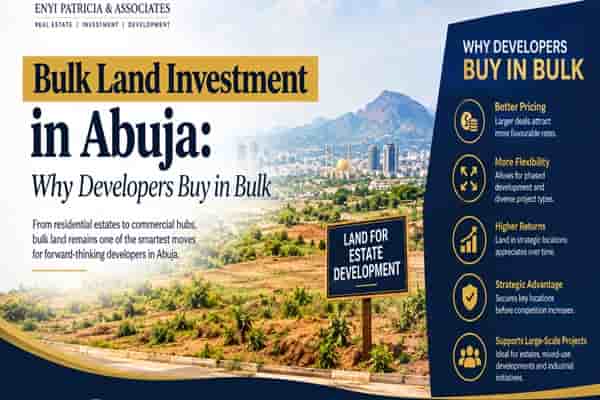
Abuja has continued to attract property investors, homebuyers and real estate developers looking for opportunities in Nigeria’s capital. As the city expands and residential communities develop across different parts of the Federal Capital Territory (FCT), more investors are paying attention to a particular strategy: buying land in large quantities before developing or reselling it.(Bulk Land Investment in Abuja: Why Developers Buy in Bulk)
This strategy, commonly known as bulk land investment, involves acquiring substantial portions of land for future development, resale, land banking or other property investment purposes.
For developers planning residential estates, gated communities, affordable housing schemes and mixed-use projects, purchasing land in bulk can provide an opportunity to secure a larger development site under a single investment strategy.
However, bulk land investment is not simply about buying as many hectares as possible. The location, legal status, infrastructure, acquisition cost and long-term development potential of the property all matter. (Bulk Land Investment in Abuja: Why Developers Buy in Bulk)
At Enyi Patricia & Associates, we recognize the importance of making informed property decisions, particularly when substantial capital is involved. book a consultation
If you are considering bulk land investment in Abuja, this guide explains why developers are interested in large land acquisitions, which locations may be worth investigating, the benefits of buying in bulk and what you should check before committing your money.
What Is Bulk Land Investment?
Bulk land investment is the acquisition of a large parcel of land, or multiple adjoining parcels, for investment or development purposes.
Rather than purchasing a single residential plot, an investor may acquire several plots, multiple hectares or a larger tract of land intended for a particular project.
The strategy is commonly used by:
- Real estate developers planning residential estates.
- Investors interested in long-term land banking.
- Companies developing housing for employees or customers.
- Property investment groups seeking larger development opportunities.
- Developers planning affordable or luxury housing communities.
- Investors who intend to subdivide and resell land, where legally permitted.
The amount of land required depends on the project’s objectives, approved land use, development density and infrastructure requirements.
For example, a developer planning a gated estate may need land for residential plots, internal roads, drainage, green spaces, utilities and other facilities.
Buying a sufficiently large and suitable parcel from the beginning may make it easier to plan the entire project as one coordinated development.
Looking for land for a major property investment? Explore the opportunities and professional guidance available through Enyi Patricia & Associates: click here.
Why Are Developers Buying Land in Large Quantities in Abuja?
There are several reasons bulk land acquisition has become an important consideration for property developers.
1. Abuja’s Expanding Residential Market
Abuja serves as Nigeria’s federal capital and attracts government employees, professionals, business owners, entrepreneurs and people relocating from other parts of the country.
These different groups have varying housing needs, ranging from affordable apartments and terraced houses to detached homes and premium residential properties.
For developers, this creates a reason to investigate locations where land can support well-planned residential projects.
As established districts become more developed, investors may also examine emerging residential corridors and satellite towns for suitable land opportunities.
However, demand differs between locations and housing categories. Developers should conduct market research rather than assume that every part of Abuja will experience the same level of growth.
2. The Opportunity to Develop an Entire Estate
One of the main attractions of bulk land investment is the ability to plan a development as a complete project.
When a developer acquires a suitably sized parcel, it may be possible to coordinate the layout, road network, drainage, utilities, housing design and community facilities more effectively.
Depending on the approved plan, the project might include:
- Detached houses.
- Semi-detached homes.
- Terraced houses.
- Apartments.
- Serviced residential plots.
- Recreational areas.
- Security facilities.
- Supporting commercial spaces, where permitted.
A coordinated approach can help developers create a more consistent community than would be possible through disconnected purchases of individual plots.
The proposed design must still comply with applicable planning requirements, environmental considerations and approved land use.
3. Greater Control Over Land Assembly
Acquiring land in bulk can help a developer secure a larger, more continuous development site.
This matters because assembling an estate from separate plots can create challenges. Some owners may refuse to sell, neighbouring parcels may have disputed boundaries, and different plots may have different documentation or ownership histories.
A single large acquisition can reduce some of these coordination challenges, provided the entire parcel has been properly surveyed and verified.
Where several adjoining properties are involved, the developer should investigate each parcel individually and confirm that the boundaries and ownership documents align.
4. The Potential to Benefit From Long-Term Land Appreciation
Some investors acquire land and hold it while monitoring development around the area.
This is known as land banking.
The investment is that a suitable parcel may become more valuable if the surrounding area attracts new roads, housing, commercial activity, utilities and other infrastructure.
However, appreciation is not guaranteed. Land may remain difficult to sell for years, and development may progress more slowly than anticipated.
The strongest land banking decisions are based on realistic acquisition prices, credible development indicators, legal security and a clear holding strategy.
5. More Flexibility in Development Planning
Developers who secure an appropriate amount of land may have more flexibility in deciding how to phase a project.
For instance, an estate may be developed in stages, beginning with essential infrastructure and an initial group of homes before expanding into additional phases.
Phasing can help a developer align construction with available funding, buyer demand and infrastructure delivery.
The ability to phase a project depends on the land’s approved layout, access, infrastructure plan and other regulatory requirements.
Best Areas to Explore for Bulk Land Investment in Abuja
There is no single location that is best for every investor. The right area depends on the intended project, budget, target customers, access requirements and the legal and planning status of the available land.
The following locations and development corridors may be worth investigating.
1. Bwari
Bwari is one of the satellite-town areas to consider when researching large land acquisitions within the FCT.
Developers may investigate suitable parcels for residential estates, family housing, affordable housing and other projects consistent with the relevant planning approvals.
Before acquiring land, assess road access, available utilities, proximity to existing communities and the cost of providing infrastructure.
Do not assume that every parcel in Bwari is available for sale or approved for residential estate development.
2. Kuje
Kuje is another area that may be relevant to investors seeking larger parcels of land within the FCT.
Depending on the precise location, developers may investigate opportunities for residential communities, housing projects and long-term land banking.
The key is to distinguish between land that is merely inexpensive and land that is commercially suitable.
A lower acquisition price may be less attractive if the parcel requires substantial road construction, drainage works or other infrastructure before development can begin.
3. Gwagwalada
Gwagwalada is a satellite town worth considering when researching land for larger residential developments.
Its suitability will depend on the specific site, the intended housing market, access to transport routes and the availability of supporting infrastructure.
Developers should investigate local housing demand, employment centres, nearby institutions and competing residential projects before determining whether a particular parcel is commercially viable. (Bulk Land Investment in Abuja: Why Developers Buy in Bulk)
4. Lugbe and the Airport Corridor
Lugbe and parts of the wider airport corridor may appeal to developers targeting residential buyers who want access to Abuja’s metropolitan areas.
Depending on the exact location, the market may support different housing formats, including terraced houses, apartments and detached homes.
However, land availability, acquisition prices, development constraints and access conditions vary considerably across the corridor.
A proper feasibility study should establish whether the expected selling prices can support the cost of acquiring and developing the land.
5. Kabusa ketty Axis
Kabusa and other developing residential corridors may be worth investigating for investors interested in larger land acquisitions.
The investment case should be based on the exact parcel, not simply the area’s reputation as an emerging location.
Confirm the approved land use, survey details, title, access and infrastructure requirements before making an offer.
6. Idu and Selected Growth Corridors
Idu is another area to look into that will be relevant to developers investigating locations connected to Abuja’s wider industrial, transportation and residential development.
However, not all land in an industrial or mixed-use growth corridor is suitable for residential estates.
Confirm the designated use of the particular parcel and determine whether the proposed project aligns with the applicable development plan.
What Is the Best Location for Bulk Land Investment?
The best location is the one that aligns with your development strategy.
A developer targeting luxury housing may have different priorities from an investor planning affordable homes or serviced plots.
Before deciding, compare:
- Land acquisition cost.
- Legal title and documentation.
- Approved land use.
- Road access.
- Infrastructure requirements.
- Nearby housing demand.
- Expected development costs.
- Competition from existing projects.
- Likely resale or rental market.
- Time required to obtain approvals and complete development.
Interested in exploring suitable land for your next project? Contact Enyi Patricia & Associates through click to discuss your preferred location, land size and investment objectives.
Five Major Benefits of Buying Land in Bulk
1. Potential Economies of Scale
In some transactions, purchasing a large parcel may result in a more favourable overall acquisition cost per hectare than buying multiple individual plots.
However, this is not automatic. The final price depends on the seller, location, title, demand and transaction structure.
Compare the total acquisition cost, including professional fees, taxes and infrastructure obligations, rather than looking at the headline land price alone.
2. A More Coordinated Development Layout
A large, suitable parcel can make it easier to design a coherent estate with connected roads, drainage systems, utility routes and shared facilities.
This can improve the organisation of the development and help reduce avoidable design conflicts.
3. The Ability to Develop in Phases
A project can potentially be divided into manageable stages, subject to planning approvals and technical feasibility.
A developer might complete the initial infrastructure and first phase of housing before proceeding with later phases.
This can help align project delivery with cash flow and actual market demand.
4. Multiple Potential Revenue Streams
Depending on the land’s permitted use and the business model, a developer may generate revenue through different activities.
These could include:
- Selling completed houses.
- Selling legally approved and properly documented serviced plots.
- Leasing residential properties.
- Retaining properties for rental income.
- Developing mixed-use components where permitted.
- Entering a suitable joint venture with another developer.
Each strategy has different funding requirements, risks and expected returns. (Bulk Land Investment in Abuja: Why Developers Buy in Bulk)
5. Long-Term Investment Opportunities
Investors with sufficient capital and a realistic holding period may consider land banking as part of a broader property portfolio.
However, land is not a liquid investment. It can take considerable time to find a buyer, and holding costs may accumulate without generating income.
Investors should consider alternative uses of their capital, market risks and the possibility that anticipated appreciation may not occur.
The Risks of Bulk Land Investment in Abuja
While large land acquisitions can offer opportunities, the financial and legal exposure can also be substantial.
1. Defective or Unclear Land Title
A seller’s possession of documents does not automatically establish that the seller has a valid, transferable interest in the property.
There may be conflicting claims, incomplete transfers, disputed ownership or other defects.
Engage a qualified property lawyer to conduct independent searches and verify the seller’s authority to transact.
2. Land Use and Planning Restrictions
A parcel may be physically large but unsuitable for the development you intend to build.
The approved use, planning conditions, road reservations, easements, environmental constraints and other restrictions can affect how the property may be developed.
Verify the relevant information with the appropriate FCT authorities before committing to the purchase.
3. Infrastructure Costs
Land with a low purchase price can become expensive when the developer must provide access roads, drainage, water, electricity and other infrastructure.
Obtain technical assessments and cost estimates before deciding whether the acquisition makes financial sense.
4. Boundary Disputes and Encroachments
Large parcels may border multiple properties, roads or community land.
A professional survey should establish the exact boundaries and help identify possible overlaps or encroachments.
Where multiple parcels are being assembled, confirm that the individual surveys correspond with the combined site.
5. Slow Sales and Cash Flow Pressure
A developer may acquire land expecting to sell plots or completed homes quickly, only to discover that demand is slower than expected.
This can tie up capital and create pressure to meet loan repayments, professional fees and infrastructure expenses.
Prepare conservative financial projections and test different sales scenarios before proceeding.
How to Verify Land Before Making a Bulk Purchase
Due diligence is essential when acquiring land on a large scale.
Before paying for hectares of land in Abuja, consider the following steps.
Step 1: Establish the Seller’s Ownership
Request the relevant title documents and verify the seller’s interest in the land.
Where the transaction involves a company, family, estate or representative, establish who has the legal authority to sell.
Step 2: Conduct Independent Title Searches
Use a qualified property lawyer to conduct the appropriate searches with the relevant authorities and investigate the history of the property.
The checks should address ownership, registration, existing interests, encumbrances and any other matters relevant to the proposed transaction.
Step 3: Commission a Professional Survey
Have a qualified surveyor establish the property’s location, boundaries and actual area.
Do not rely solely on a seller’s estimate of the number of hectares.
Step 4: Confirm the Approved Land Use
Check whether the property can legally accommodate the intended development.
If the proposed project requires a change of use, subdivision or other approvals, establish the requirements and risks before purchasing.
Step 5: Assess the Site’s Physical Condition
Arrange appropriate technical assessments of topography, soil conditions, drainage, flood exposure, access and other site-specific considerations.
These factors can significantly influence development costs.
Step 6: Prepare a Feasibility Study
Estimate the full cost of acquisition, approvals, infrastructure, construction, marketing, financing and contingencies.
Compare the total expected cost with realistic revenue projections.
Step 7: Use a Properly Prepared Sale Agreement
The transaction documents should accurately describe the property, payment terms, completion obligations, representations and remedies if agreed conditions are not met.
Have your lawyer review the documents before funds are released.
How Much Land Should a Developer Buy?
The answer depends on the proposed project.
A small residential community may require several hectares, while a large estate or mixed-use development may require considerably more.
There is no universal acreage or hectare requirement for every estate.
The appropriate land size should be determined by the intended number of homes, plot sizes, permitted density, internal roads, drainage, utilities, green spaces, community facilities and planning conditions.
For example, a developer planning a high-density residential project may use land differently from a developer planning detached houses on large plots.
The important point is to calculate the land requirement from the development concept instead of buying an arbitrary number of hectares.
Is Bulk Land Investment Better Than Buying Individual Plots?
Neither approach is automatically better. The choice depends on your resources and objectives.
Bulk land investment may be suitable if you:
- Intend to develop an estate or a larger housing scheme.
- Have sufficient capital for acquisition and due diligence.
- Can manage infrastructure and planning requirements.
- Have a realistic development or resale strategy.
- Can tolerate a potentially long investment period.
Buying individual plots may be more suitable if you:
- Have a smaller investment budget.
- Want to acquire land gradually.
- Do not need a large continuous development site.
- Prefer to spread purchases across different locations.
Investors should compare total costs, legal risks, liquidity and expected returns before selecting either strategy.
How Enyi Patricia & Associates Can Help With Your Land Investment Goals
Finding land is only the first step in a successful property investment.
A good acquisition should fit the investor’s budget, intended use, development plan and risk tolerance.
Enyi Patricia & Associates works with clients interested in real estate opportunities and property decisions, with an emphasis on understanding their requirements and identifying suitable options.
If you are exploring bulk land investment, it is important to establish your preferred location, required land size, budget, intended development and acquisition timeline.
These details help create a clearer basis for assessing potential opportunities.
Whether you are considering land banking, a residential estate or another development project, conduct the necessary independent legal, survey and planning checks before completing any transaction.
Ready to discuss your land acquisition requirements? book a consultation to connect with Enyi Patricia & Associates and take the next step towards a more informed property investment decision.
Conclusion: Is Bulk Land Investment in Abuja Worth Considering?
Bulk land investment can provide opportunities for developers who want to build residential estates, establish housing projects or hold suitable land for the long term.
Locations such as Bwari, Kuje, Gwagwalada, Lugbe, Kabusa and selected development corridors may be worth investigating, depending on the project and the availability of appropriately documented land.
However, success depends on much more than purchasing a large parcel.
The land must have a verifiable title, suitable planning status, workable access, manageable infrastructure requirements and a credible commercial purpose.
Before committing your capital, conduct independent due diligence, prepare a feasibility study and understand the risks involved.
At Enyi Patricia & Associates, our goal is to help clients approach property opportunities with better information and a clearer understanding of their investment objectives. click to start
If you are considering bulk land investment in Abuja, start by defining what you want to achieve, the amount of land you need and the type of development you intend to pursue.
A well-researched acquisition is a stronger starting point for building a sustainable property investment.
Frequently Asked Questions About Bulk Land Investment in Abuja
What is bulk land investment?
Bulk land investment involves purchasing a large parcel of land or multiple adjoining parcels for development, resale, land banking or another investment purpose.
Where can I find large parcels of land in Abuja?
Areas worth investigating include Bwari, Kuje, Gwagwalada, Lugbe, Kabusa and selected development corridors. Availability, title, approved land use and suitability vary by property.
Is buying land in bulk cheaper than buying individual plots?
It can be, depending on the negotiated price and transaction structure. However, legal fees, infrastructure, access and development costs can affect the total cost significantly.
What documents should I verify before buying bulk land?
Depending on the property, relevant documents may include a Certificate of Occupancy, Right of Occupancy, Deed of Assignment, survey plan, allocation documents and other records establishing the seller’s interest. A lawyer should verify the applicable documentation independently.
Can I buy land in bulk for estate development?
Potentially, yes, provided the property is legally available and its approved land use, planning conditions and physical characteristics support the proposed development. The necessary approvals must be obtained.
Is land banking in Abuja profitable?
Land banking can produce a return if the property appreciates and is eventually sold at a price that exceeds the acquisition and holding costs. However, appreciation may be slow, and land can be difficult to sell quickly in some cases but it will definitely yield profit as other factors which leads to land appreciation are consider before the land investment
What should I consider before buying hectares of land?
Consider the title, approved use, location, survey, access, infrastructure costs, environmental conditions, local housing demand, acquisition price and expected development or resale returns.
Looking for bulk land investment opportunities in Abuja? Contact Enyi Patricia & Associates to discuss your property requirements and investment objectives.Where to Buy Hectares of Land in Abuja for Estate Development click here




Join The Discussion